TCL 5G AI CPE X5 Brings Agentic AI to Home Broadband
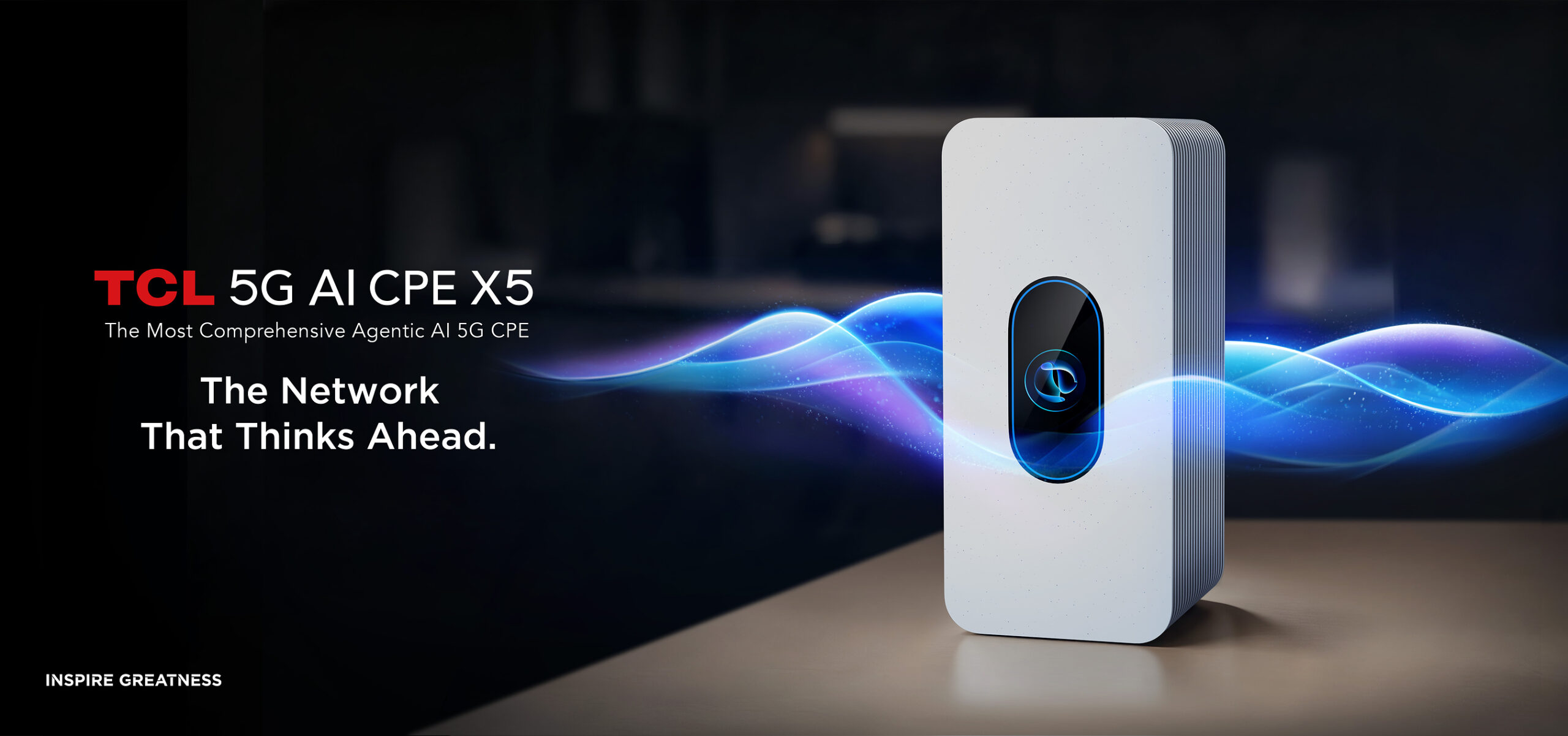
TCL 5G AI CPE X5 is designed to make home broadband more intelligent by combining 5G connectivity, AI-powered network optimisation and automated troubleshooting in a single device. Showcased at Network X 2026 in Vienna on October 13, the new gateway uses agentic AI to interpret user requests, adjust supported network settings and help resolve connectivity problems without requiring users to navigate complex router menus.
The device targets homes and small businesses that rely on stable connectivity for remote work, online gaming, video streaming and connected-home devices. TCL is positioning the X5 as more than a conventional broadband gateway, with plans to extend its role into a broader connected-living platform.
The launch reflects a shift in networking hardware towards systems that can analyse conditions, make decisions and carry out defined actions rather than simply provide an internet connection.
TCL 5G AI CPE X5 Uses Agentic AI to Manage Networks
The X5 features a unified AI architecture designed to translate natural-language instructions into supported network actions. Users can, for example, ask the device to optimise the network for gaming, allowing its AI agent to assess conditions and adjust relevant settings.
This approach aims to make network management more accessible to people who may not understand technical concepts such as channel selection, traffic prioritisation or connection settings.
According to TCL, the system coordinates network sensing, decision-making, execution and recovery. Its agent can work across supported functions, including network checks, traffic management, operating-mode changes and compatible-device control.
The practical benefit is intended to be a simpler experience: users express what they want to achieve, while the system handles the underlying configuration where supported. The range of actions available will depend on software capabilities and device compatibility.
TCL 5G AI CPE X5 Combines AI With Advanced 5G Connectivity
The X5 uses AI-assisted cellular reception management to help select antenna configurations based on signal conditions. Its 8Rx architecture combines four directional C-band antennas with four omnidirectional C-band antennas.
TCL reports that the design delivered up to 51% higher downlink throughput than a 4Rx configuration in laboratory testing. The device supports 3GPP Release 18 and has a stated theoretical peak download rate of 7.01 Gbps.
These figures describe the manufacturer’s stated capabilities rather than guaranteed real-world performance. Actual speeds will depend on network availability, spectrum, signal strength, operator deployment and other environmental factors.
The gateway also applies AI-assisted techniques to indoor Wi-Fi, including signal-path selection, congestion detection and channel adjustment. The aim is to maintain a more stable connection as household devices compete for wireless capacity.
By combining cellular and Wi-Fi optimisation, TCL is seeking to address performance across the full connection path, from the mobile network to devices inside the home.
TCL 5G AI CPE X5 Offers Automated Network Diagnosis
The device is designed to monitor several parts of the network, including Wi-Fi, local area network connections, cellular connectivity and system operation.
When it identifies a supported issue, the system can investigate the cause, initiate a recovery action, verify the result and record the outcome. TCL lists potential recovery scenarios involving certain congestion conditions, module anomalies, resource overload and configuration drift.
This closed-loop approach could reduce the need for users to restart equipment manually or contact their internet service provider for every connectivity problem. Network health reports are also intended to give users and support teams greater visibility into device performance.
Where operator integration is enabled, local diagnostics can be connected to cloud management systems and service-provider support workflows.
Automated recovery will not eliminate every network issue, particularly problems caused by external outages, physical damage or service-provider infrastructure. Its value will depend on how accurately the device diagnoses problems and how effectively its supported recovery actions work.
TCL 5G AI CPE X5 Prioritises Applications and Manages Power
The X5 includes application-aware quality of service (QoS), designed to recognise supported types of traffic, such as gaming, streaming and video calls. When several applications share the same connection, the gateway can prioritise selected latency-sensitive traffic to help improve responsiveness.
This is particularly relevant for households where multiple people work, study or play online at the same time. However, prioritisation can help manage available bandwidth; it cannot remove the limitations of an overloaded external network or an insufficient broadband plan.
The device also features adaptive power management that adjusts operating modes according to usage scenarios and application traffic. Device identification tools help users spot unfamiliar devices, while AI-assisted traffic analysis is designed to detect certain unusual access patterns.
Parental controls and guest-access settings provide additional ways to manage who can use the network and how connected devices access it.
TCL 5G AI CPE X5 Expands Into a Connected-Living AI Hub
TCL’s longer-term vision positions the X5 as a connected-living AI hub rather than solely a networking product. The proposed architecture combines on-device computing, a unified AI operating system and a home computing centre intended to support local coordination of multiple AI agents.
The company also describes plans for integrated model and skill stores, alongside a unified runtime to support additional capabilities and developer deployment. The broader ecosystem could extend selected functions to compatible network-attached storage (NAS) devices, AI cameras and mesh networking equipment.
TCL’s emphasis on local processing also points towards a connected-home experience in which supported tasks can be executed without always relying on cloud services. The actual privacy benefits will depend on which tasks run locally, what data is shared externally and how the device’s security controls are implemented.
These capabilities represent TCL’s broader product vision; not every proposed function should be interpreted as available in the current device configuration.
TCL 5G AI CPE X5 Highlights the Future of Broadband
The X5 forms part of TCL’s wider connectivity portfolio, which also includes 5G fixed wireless access equipment, Wi-Fi 8 devices and other connected products. The company is exploring how AI and next-generation networking can help service providers offer more differentiated services while reducing the workload associated with network operations.
For consumers, the appeal of an AI-enabled gateway will depend on whether it makes everyday tasks genuinely easier: improving a gaming connection, identifying a recurring fault or helping manage unfamiliar devices. For operators, automated diagnostics and remote management could help streamline support, although the financial benefits will depend on implementation and scale.
The TCL 5G AI CPE X5 illustrates how broadband hardware is moving towards a combination of connectivity, automation and user-facing intelligence. Its long-term success will depend on real-world network performance, the reliability of AI actions, operator support and the availability of the wider connected-home ecosystem.