Fibocom SC153 5G Smart Module Targets Next-Generation Connected Devices
Fibocom SC153 5G Smart Module is designed to help manufacturers build a new generation of connected devices with high-speed cellular connectivity, flexible hardware interfaces and Android-based software support. Unveiled at Network X 2026, the module combines a Qualcomm processing platform with 5G networking capabilities for applications ranging from industrial equipment to smart retail and other intelligent devices.
The launch comes as manufacturers increasingly integrate AI-enabled functions into connected products. These devices need more than basic internet access: they require reliable data transmission, computing capabilities and hardware that can accommodate different designs without forcing companies to develop every component from scratch.
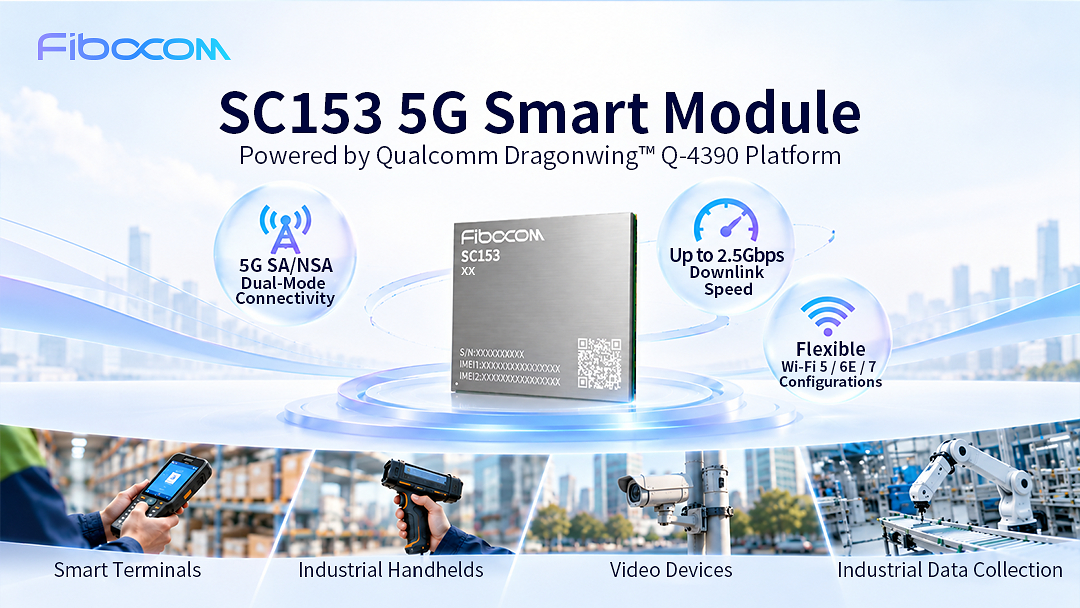
Fibocom says the SC153 is built on Qualcomm’s Dragonwing Q-4390 platform. The module was being showcased at Network X in Vienna on October 13, 2026, with mass production planned for the fourth quarter of 2026. It is currently undergoing debugging, meaning the announced production timeline remains a future target.
Fibocom SC153 5G Smart Module Delivers High-Speed Connectivity
The SC153 supports 3GPP Release 16 and cellular connectivity across 5G New Radio (NR) sub-6 GHz and LTE networks. It is designed to work with both standalone (SA) and non-standalone (NSA) 5G network architectures, giving device manufacturers flexibility when deploying products across different network environments.
According to Fibocom, the module supports maximum download speeds of up to 2.3 Gbps in 5G SA mode and 2.5 Gbps in NSA mode using dual connectivity. These are theoretical peak figures; actual performance will depend on network coverage, spectrum availability, operator configuration and the device’s implementation.
The connectivity capabilities are intended for products that need to move substantial amounts of data, including high-definition video devices, industrial data collection equipment and connected smart devices.
As more equipment relies on remote monitoring, cloud-connected applications and real-time information exchange, cellular modules have become an important component in product design. Integrating 5G connectivity into a ready-made module can reduce the amount of wireless hardware and software that manufacturers need to develop independently.
Fibocom SC153 5G Smart Module Offers Flexible Hardware Integration
The SC153 uses a land grid array (LGA) package and includes a range of interfaces intended to support different device configurations. These include MIPI display, USB 3.1, UART, I²C and SD interfaces, allowing manufacturers to connect displays, peripherals and other components according to their product requirements.
The module also supports configurations involving Wi-Fi 5, Wi-Fi 6E and Wi-Fi 7, depending on the implementation. This gives device developers options for combining cellular connectivity with local wireless networking.
Hardware flexibility matters because connected products vary significantly in size, power requirements and intended use. A smart retail terminal, industrial handheld device and robotics system may all need cellular communication, but their displays, sensors, peripherals and software requirements can be very different.
By providing a common connectivity and processing foundation, the SC153 aims to simplify integration and help manufacturers move from development to product validation more efficiently.
Fibocom SC153 5G Smart Module Supports Android Development
The SC153 supports Android, giving manufacturers a familiar software environment for developing applications and customising device experiences. Android support can help development teams build user interfaces, integrate compatible applications and adapt software to specific industry requirements.
The module’s combination of processing hardware, cellular connectivity and peripheral interfaces is intended to support a broad range of connected-device designs. Potential application areas include smart retail equipment, industrial handheld terminals, robotics and other intelligent devices.
For manufacturers, a module-based design can reduce the need to engineer a complete communications subsystem independently. It can also help standardise parts of the development process across multiple product models.
However, the final capabilities of any device will depend on its complete hardware design, software configuration, certifications and integration work. The module itself provides a platform for development rather than guaranteeing that every potential application will be available out of the box.
Fibocom SC153 5G Smart Module Connects Qualcomm and Fibocom Technologies
The collaboration brings together Fibocom’s wireless module expertise and Qualcomm Technologies’ processing platform. Qualcomm’s Dragonwing portfolio is aimed at connected and intelligent edge devices, while Fibocom develops cellular modules and associated hardware and software solutions for industrial and commercial applications.
The partnership reflects a wider industry trend: device manufacturers are looking for integrated platforms that combine connectivity and computing while reducing engineering complexity.
Qualcomm Technologies said the convergence of 5G and application processing is creating opportunities for new smart-device designs. Fibocom, meanwhile, sees the SC153 as an addition to its portfolio for manufacturers seeking flexible connectivity options and more efficient product development.
The companies intend to use this combination to support a broader range of connected devices as AI-related applications increasingly extend beyond cloud services and into products operating at the network edge.
Fibocom SC153 5G Smart Module Targets Industrial and Smart Devices
The SC153 is intended for manufacturers developing products where stable wireless connectivity and customisable hardware are important. Industrial equipment can use cellular links for data collection and remote monitoring, while smart retail systems may depend on connected terminals and real-time information exchange. Robotics and other intelligent devices can also require reliable communication with cloud services or remote management platforms.
The module’s appeal will depend on how well it meets individual product requirements, including supported frequency bands, local network compatibility, thermal design, certification and software support. Manufacturers will also need to validate the complete device before commercial deployment.
With mass production planned for late 2026, the next stage will be moving from demonstration and debugging to product integration and qualification by device makers.
Fibocom’s SC153 highlights how 5G modules are evolving into more integrated building blocks for connected products. By combining high-speed cellular networking, processing capabilities and flexible interfaces, the company aims to help manufacturers develop intelligent devices without designing every element of the underlying connectivity platform from the ground up.