
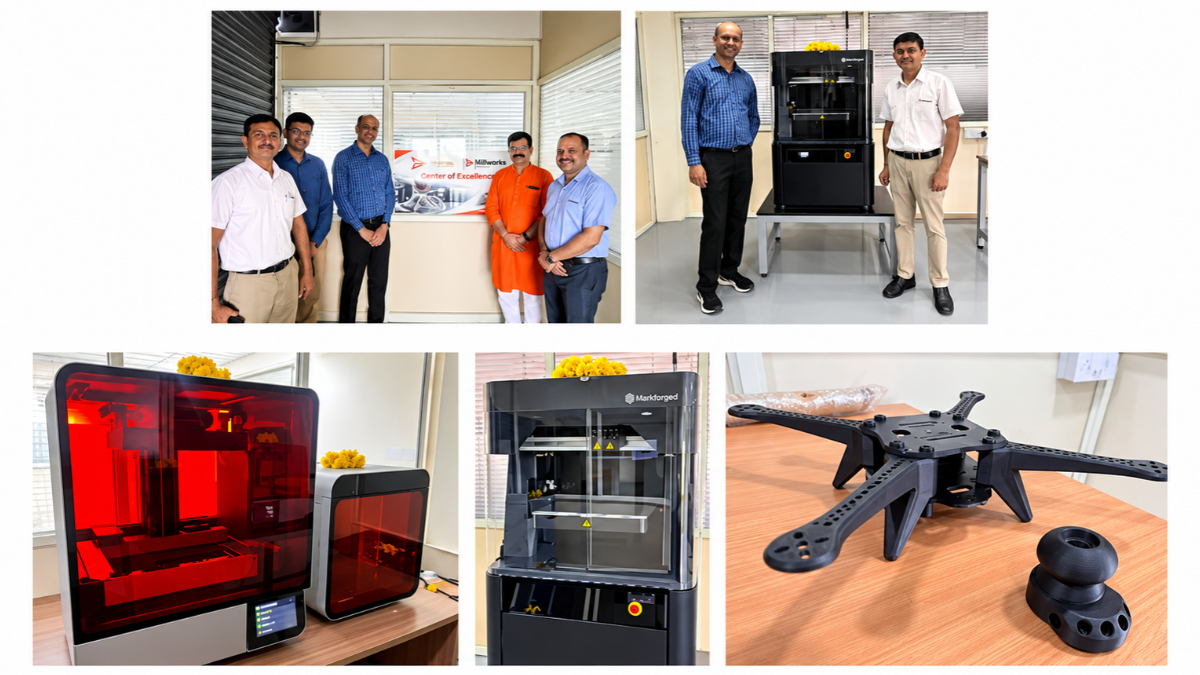
Millworks Technologies 3D Printing Centre Targets Aerospace and Defence Prototyping
Millworks Technologies has established a Centre of Excellence for 3D printing at its Bengaluru facility in collaboration with US-based Markforged Holding Corporation. The new facility is designed to accelerate the development of carbon-fibre composite and polymer components for aerospace and defence customers, adding advanced manufacturing capabilities to the company’s precision-engineering operations.
The centre houses seven machines, including industrial 3D printers, post-processing systems and 3D scanning equipment. By bringing these capabilities together under one roof, Millworks aims to shorten product-development cycles and respond more quickly to customer requirements for new programmes.
The development expands the company’s manufacturing capabilities beyond conventional machining and fabrication, allowing it to produce functional prototypes, development components, fixtures and tooling through additive manufacturing.
Millworks Technologies 3D Printing Centre Combines Multiple Manufacturing Technologies
The new centre includes equipment for continuous-fibre composite printing, resin-based printing, large-format fused deposition modelling (FDM) and 3D scanning.
Its equipment includes the Markforged FX10 industrial composite printer and Mark Two (Gen 2) continuous-fibre printer. The facility also houses Formlabs Form 4L and Form 4 resin printers with post-processing systems, a MetaForm 700 large-format FDM printer and a 3DeVOK MT 3D scanner.
Together, these machines support different stages of product development, from producing prototype parts to finishing components and inspecting their dimensions.
The combination is intended to give engineering teams greater flexibility when selecting materials and manufacturing methods for specific applications. Rather than relying exclusively on conventional machining or external suppliers for every development component, teams can use the centre to test designs and refine parts within an integrated workflow.
The company expects this capability to help reduce development timelines, although actual improvements will depend on component complexity, material requirements and the production process involved.
Millworks Technologies 3D Printing Centre Supports Aerospace and Defence Applications
A key focus of the facility is the production of components for aerospace and defence programmes, where engineering teams may need to evaluate designs, validate fit and function, and refine components before moving towards larger-scale manufacturing.
The centre supports printing with continuous carbon fibre, Kevlar, fibreglass and high-temperature fibreglass, alongside resin-based materials. These options give engineers different material characteristics to consider when developing prototypes and tooling.
Additive manufacturing can be useful during early-stage development because it allows certain parts to be produced directly from digital designs without the same tooling requirements associated with some conventional manufacturing methods. Design changes can then be incorporated into subsequent iterations.
However, a printed prototype is not automatically suitable for operational use. Components intended for aerospace and defence applications may require extensive testing, qualification and certification before they can be approved for use in safety-critical environments.
Millworks’ stated objective is to support development and prototyping requirements, helping customers evaluate components and progress engineering programmes more efficiently.
Millworks Technologies 3D Printing Centre Uses Markforged Digital Forge
The centre operates on Markforged’s Digital Forge platform, which connects industrial 3D printers, engineering-grade materials and software into a manufacturing workflow.
The platform is designed to support the production of parts on demand, allowing engineering teams to move from digital designs to physical components without depending entirely on conventional production routes.
For Millworks, integrating the platform with its existing engineering capabilities creates an additional option for customers developing components and assemblies. The company can combine additive manufacturing with its established precision machining, sheet-metal fabrication, welding, laser cutting and inspection operations.
This combination could be useful when a project requires different manufacturing processes at different stages. Additive manufacturing may support prototyping and specialised tooling, while conventional processes remain important for components that require specific tolerances, finishes or production volumes.
The effectiveness of the integrated approach will depend on how well the technologies fit individual customer requirements, including material performance, dimensional accuracy, repeatability and cost.
Millworks Technologies 3D Printing Centre Expands Integrated Engineering Capabilities
Millworks Technologies manufactures machined components, sheet-metal parts and integrated assemblies for sectors including railways, aerospace, defence and semiconductors.
The company operates through both Build-to-Print and Build-to-Spec models. Under a Build-to-Print arrangement, a manufacturer produces components according to customer-provided designs and specifications. Build-to-Spec engagements can involve a broader role in developing a solution to meet the customer’s requirements.
The new centre adds another manufacturing option to this portfolio. Its combination of printing, post-processing and scanning is intended to support customers from early development through component refinement and inspection.
For industrial customers, access to integrated capabilities can help simplify coordination between design, prototyping and manufacturing teams. It may also reduce the time spent moving components between separate suppliers, depending on the scope of a project.
The centre’s initial focus on aerospace and defence reflects the requirements of sectors where engineering development can involve complex components, specialised materials and lengthy qualification processes.
Millworks Technologies 3D Printing Centre Signals Investment in Advanced Manufacturing
The establishment of the centre represents an investment in additive manufacturing as a complement to conventional precision engineering. As manufacturers look for ways to accelerate development and produce specialised components, industrial 3D printing offers another route for prototyping, tooling and selected end-use applications.
For Millworks, the immediate opportunity lies in supporting customer development programmes with a broader set of in-house capabilities. The longer-term commercial impact will depend on customer adoption, the range of projects secured and the ability to translate development work into sustained manufacturing relationships.
The facility does not replace the need for traditional manufacturing methods. Instead, it expands the options available to engineers when deciding how to design, test and produce components.
By combining Markforged printing technology with resin printing, large-format FDM and 3D scanning, Millworks is positioning the new centre as an integrated resource for customers developing components for demanding industrial applications.