
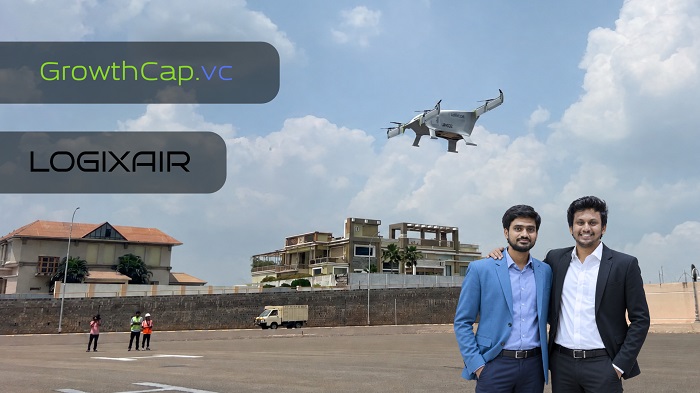
LogiXair Aerial Cargo Network Gets GrowthCap Ventures Backing
Hyderabad-based aerospace startup LogiXair has secured investment from GrowthCap Ventures and a group of angel investors with professional backgrounds at Honeywell Aerospace to develop its autonomous aerial cargo network for India and international markets.
The company is developing hybrid-electric vertical take-off and landing (VTOL) aircraft designed to transport cargo between metropolitan areas, industrial hubs and Tier II and Tier III cities without relying on conventional runways. Its proposed network targets short-haul logistics routes of up to 600 kilometres, an area where road transport can face delays and conventional aviation infrastructure may be impractical.
The investment will support engineering development, technology validation and commercialisation. The financial terms and total amount raised in the latest round have not been disclosed in the announcement.
Founded by Bhanu Teja Chidura and Pulla Kapil, LogiXair is building an integrated system that combines autonomous aircraft, cargo-handling equipment and fleet operations software. The company aims to establish an additional layer of logistics infrastructure alongside existing road, rail and air transport networks.
LogiXair Aerial Cargo Network Targets India’s Middle-Mile Logistics
Moving goods between major cities and smaller industrial or commercial centres remains an important part of India’s logistics infrastructure. Road transport provides extensive coverage, but delivery times can be affected by congestion, terrain and the distance between distribution hubs.
LogiXair is targeting this middle-mile segment with autonomous aircraft designed to move cargo directly between locations that may not have convenient access to conventional aviation facilities.
The company sees potential applications across industrial supply chains, offshore operations, defence logistics and deliveries to locations where ground transportation is slow or difficult. Its longer-term plans include international markets, with Europe and Asia-Pacific identified as potential opportunities.
The proposed approach would not replace road and rail networks across the board. Instead, aerial cargo could offer an alternative for specific routes where speed, access or operational flexibility justifies the cost of operating an aircraft.
The commercial case will depend on factors including payload, route length, aircraft utilisation, maintenance, regulatory permissions and the availability of suitable landing and cargo-handling locations.
LogiXair Aerial Cargo Network Centres on the L560 Aircraft
At the centre of the company’s plans is the L560, an autonomous hybrid-electric VTOL aircraft designed to carry cargo loads of up to 300 kilograms over distances of up to 600 kilometres, according to the company announcement.
VTOL aircraft can take off and land vertically, reducing the need for conventional runways. This characteristic could make the technology suitable for connecting logistics hubs where building or accessing airport infrastructure would be difficult.
The hybrid-electric propulsion system is intended to combine electric power with another energy source, supporting the aircraft’s planned range and payload capabilities. LogiXair is also developing modular cargo containers to support different types of loads and operational requirements.
The L560’s stated payload and range are design targets rather than confirmation of established commercial performance. The company says it has flight-tested sub-scale prototypes and validated its hybrid-electric powertrain, while continuing development towards commercialisation.
Demonstrating that a full-scale aircraft can consistently meet its target payload, range, safety and operating-cost requirements will be an important next step.
LogiXair Aerial Cargo Network Combines Aircraft and Ground Automation
LogiXair’s proposed system extends beyond the aircraft itself. The company is also developing autonomous ground-handling equipment and fleet operations software intended to coordinate cargo movements and aircraft activity.
Ground automation could help streamline the process of preparing cargo, loading aircraft and managing operations between flights. Fleet software, meanwhile, can support the monitoring and coordination of multiple autonomous aircraft.
Integrating these components could allow operators to manage aerial cargo as a logistics service rather than treating each flight as a separate operation. However, the efficiency of such a system will depend on how reliably the aircraft, ground equipment and software work together in real operating conditions.
LogiXair says it has developed six intellectual property assets and reached Technology Readiness Level 6 (TRL 6) across its technology development. This readiness level generally indicates that a technology has been demonstrated in a relevant environment, but it does not by itself establish commercial readiness or regulatory approval for routine cargo operations.
The company’s work therefore remains focused on engineering validation and preparing its technology for deployment.
LogiXair Aerial Cargo Network Draws on Aerospace and Defence Experience
The startup says its engineering team spans aerospace engineering, autonomous systems, robotics and software. It is also working with the Defence Research and Development Organisation (DRDO) and other aerospace and defence original equipment manufacturers on technology validation against operational requirements.
The company reports that revenue from its defence engineering work is helping support its development programme. This provides a potential source of commercial activity alongside its longer-term plans for autonomous cargo logistics.
The involvement of angel investors with Honeywell Aerospace backgrounds adds industry experience to the investment round, while GrowthCap Ventures brings early-stage investment support.
For an aerospace startup, technical expertise and capital are both important because aircraft development involves extensive testing, engineering iteration and regulatory work before commercial services can scale. Partnerships with experienced industry organisations may help inform product development, although future commercial agreements and deployment plans will need to be confirmed separately.
LogiXair Aerial Cargo Network Investment Supports Commercialisation
GrowthCap Ventures’ investment is intended to help LogiXair continue engineering development, validate its technology and move towards commercialisation. The company has not disclosed the amount invested or a specific date for launching regular L560 cargo operations.
The next milestones will include demonstrating the aircraft’s performance against its intended payload and range, securing the required approvals and establishing operational partnerships with logistics and industrial customers.
The opportunity extends beyond India. If the technology can meet its performance and cost targets, autonomous VTOL aircraft could serve selected routes in markets where conventional transport infrastructure presents constraints. However, international expansion would require compliance with the aviation regulations and operating requirements of each market.
LogiXair’s progress will ultimately depend on turning its aircraft and supporting software into a reliable logistics service. The investment provides backing for that process, while the company’s engineering validation and commercial partnerships will determine how quickly its aerial cargo network can move from development towards regular operations.