DocuGenie.AI Conversational AI Brings Natural Language Queries to Enterprise Documents
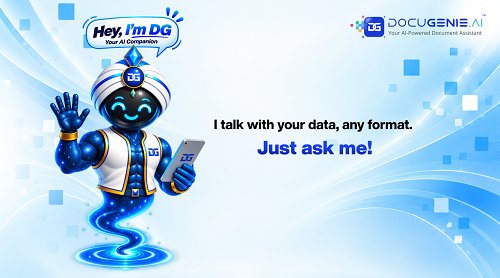
SecureKloud Technologies has introduced “Hey, I’m DG”, a conversational AI feature within its DocuGenie.AI platform, designed to help enterprise users retrieve and understand information from documents using everyday language.
The feature allows users to ask questions about business records and receive answers, summaries and supporting references, reducing the need to manually search through lengthy files or switch between multiple information systems. The launch expands DocuGenie.AI beyond document processing towards a more interactive approach to enterprise information management.
For organisations that handle large volumes of financial statements, loan applications, customer records and operational documents, the ability to locate relevant information quickly can influence how efficiently teams review cases and make decisions.
DocuGenie.AI Conversational AI Moves Beyond Document Search
DocuGenie.AI already supports the ingestion, classification, extraction and validation of information from structured and unstructured documents. The new “Hey, I’m DG” feature adds a conversational layer, allowing users to explore processed information through natural-language questions.
Instead of locating individual files and searching for specific terms, employees can ask questions in a more direct way. The platform is designed to return contextual responses linked to underlying source information, helping users trace answers back to relevant records.
This distinction is important in enterprise environments, where finding a document is often only the first step. Teams may also need to compare information across files, understand discrepancies or identify missing details before taking action.
The feature is intended to make this process more accessible to employees who may not be familiar with complex search tools or technical query systems.
DocuGenie.AI Conversational AI Targets Banking and Lending Workflows
Banking and financial services are among the key use cases outlined by SecureKloud. Employees could use the feature to investigate factors contributing to loan defaults, identify applications awaiting review, or check for missing documents and pending legal verifications.
These capabilities complement DocuGenie.AI’s existing offerings in bank statement analysis and Loan Against Property automation. When integrated with relevant enterprise systems, the platform can also bring together information from documents and lending applications, including Loan Origination Systems and Loan Management Systems.
Such applications could help teams reduce repetitive manual checks and identify cases that require closer attention. However, AI-generated responses would still need appropriate human review, particularly when they inform lending decisions, compliance checks or other consequential business processes.
The company positions the feature as a way to help employees spend less time gathering information and more time evaluating it.
DocuGenie.AI Conversational AI Extends to Logistics Operations
The new capability is also designed for document-heavy logistics operations. Teams can use conversational queries to investigate shipment exceptions, examine supporting paperwork and understand discrepancies across operational records.
In logistics, relevant information may be distributed across shipping documents, internal records and connected business applications. Bringing these sources into a more accessible interface could make it easier for employees to investigate delays or inconsistencies without repeatedly searching separate systems.
The potential benefit depends on the quality of the underlying data, the systems connected to the platform and how well the AI interprets the available information. Nevertheless, the approach reflects a wider enterprise technology trend: making business data easier to query without requiring users to navigate every system individually.
DocuGenie.AI supports document automation across several sectors, including lending, onboarding, logistics and manufacturing, giving the conversational feature a range of potential applications.
DocuGenie.AI Conversational AI Supports Secure, Traceable Information Access
A key element of the feature is its use of supporting references alongside responses. In enterprise settings, traceability matters because users need to understand where an answer originated and verify whether it accurately reflects the underlying record.
Providing source references can make it easier to review information and investigate discrepancies. It does not, by itself, eliminate the possibility of errors, so organisations will need suitable governance, access controls and verification processes when deploying conversational AI.
These considerations are especially relevant when systems handle sensitive financial, customer or operational information. Enterprises must assess how data is accessed, protected and retained, as well as how AI-generated outputs are used in business decisions.
SecureKloud describes DocuGenie.AI as part of its broader portfolio of AI, cloud and automation solutions for enterprise operations.
DocuGenie.AI Conversational AI Advances the Digital Workforce Vision
The launch also aligns with SecureKloud’s stated ambition to develop an AI-powered digital workforce in which intelligent assistants work alongside employees to simplify everyday tasks.
The idea is to integrate AI into existing workflows rather than treat it as a separate destination. In this model, employees can ask questions about business information within a familiar conversational interface, while the underlying platform handles document processing and information retrieval.
For businesses, the value of this approach will ultimately depend on response accuracy, integration with existing systems, data security and the extent to which it improves productivity in real operating conditions.
With “Hey, I’m DG”, SecureKloud is extending DocuGenie.AI from document automation towards conversational enterprise intelligence. The next measure of progress will be how effectively organisations can use the capability to find reliable information, reduce repetitive work and support better-informed decisions.