
Advantech SOM-5994 Brings Intel Atom P6900 Processing to High-Density Edge Networks
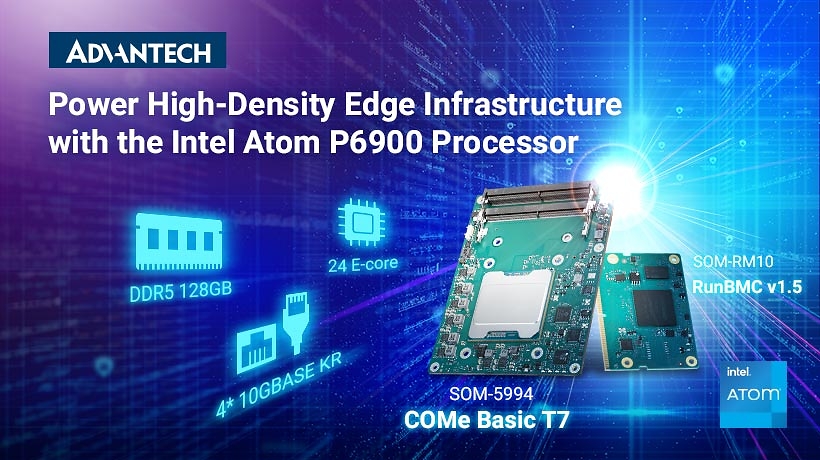
Advantech has launched the SOM-5994, a high-density embedded computing module powered by Intel Atom P6900 processors, designed for next-generation edge networking, 5G infrastructure and telecommunications equipment. The COM Express Basic Type 7 module supports configurations ranging from 8 to 24 processor cores, up to 128GB of DDR5 memory and multiple high-speed Ethernet interfaces, targeting network equipment manufacturers and system integrators developing data-intensive infrastructure.
Announced on November 10, 2026, the module is designed to handle workloads such as packet processing, network security, virtualisation and software-defined networking (SDN). Advantech is combining the hardware with its Computer-on-Module (COM) design-in services, which include carrier board development, BIOS customisation, thermal design guidance and system validation.
The company plans to make the SOM-5994 available in the second quarter of 2027. Its launch comes as telecom operators and infrastructure developers face growing demands for higher network throughput, lower latency and more computing capacity closer to where data is generated.
Advantech SOM-5994 Targets High-Density Network Processing
The SOM-5994 uses Intel Atom P6900 Series processors, also known by the codename Grand Ridge. The processor family is designed for networking and telecommunications workloads, with configurations ranging from 8 to 24 efficient cores and thermal design power (TDP) options between 50W and 86W.
This range gives equipment manufacturers flexibility to select a configuration based on processing requirements, power budgets and thermal constraints. High core density is particularly relevant to network appliances that need to handle several concurrent tasks, including traffic inspection, routing, security processing and virtualised network functions.
Advantech positions the module as a platform for applications that require substantial computing capacity within a standardised embedded form factor. The COM Express Basic Type 7 design is intended to help developers integrate the module into compatible carrier-board architectures rather than building an entirely new computing platform from scratch.
The company says the Intel Atom P6900-based platform delivers higher overall performance than the Intel Xeon D-1700 processor family. This is a manufacturer-reported comparison, and actual performance will depend on the processor configuration, workload and system design.
Advantech SOM-5994 Supports DDR5 Memory and High-Speed Ethernet
Memory and connectivity are central to the SOM-5994’s design. The module supports dual-channel DDR5-5600 SODIMM memory with a capacity of up to 128GB, providing the bandwidth and memory capacity needed for demanding networking applications.
On the expansion side, it offers up to 16 PCIe Gen4 lanes and 16 PCIe Gen3 or Gen2 lanes. These interfaces allow system designers to connect additional networking, storage and acceleration components, depending on the final carrier-board configuration.
For network connectivity, the SOM-5994 integrates four 10GBASE-KR Ethernet interfaces designed for backplane applications, alongside an Ethernet controller supporting speeds of up to 2.5GbE.
The combination is intended to support network appliances that need to process large volumes of data across multiple interfaces. Potential applications include packet inspection, network security systems, software-defined networking platforms and telecom infrastructure equipment.
The module also provides four USB 3.0 ports and SATA 3 connectivity, giving manufacturers additional options when designing systems around the platform.
Advantech SOM-5994 Offers Support for Industrial Deployments
The SOM-5994 has an optional extended operating temperature range of -40°C to 85°C, making it suitable for industrial environments where equipment may be exposed to more demanding temperature conditions.
This is relevant for telecom and edge infrastructure installations that may operate in equipment rooms, industrial facilities and locations without the controlled environment of a conventional data centre.
The module also supports Yocto Linux integration, Advantech SUSI APIs, embedded BIOS features and DeviceOn. These tools are intended to support software development, hardware monitoring and system management.
Another option is the SOM-RM10 BMC carrier card. When paired with this card, the platform can support out-of-band management, allowing operators to monitor systems, perform remote debugging and initiate automated recovery without relying entirely on the host operating system.
Remote management can be particularly useful when network equipment is deployed across geographically distributed locations, where sending technicians for every maintenance requirement can increase operational costs.
Advantech SOM-5994 Combines Hardware With Design-In Services
Beyond the module itself, Advantech is emphasising the engineering support available to original equipment manufacturers (OEMs) and system integrators.
Its COM design-in services cover carrier-board design support, BIOS customisation, thermal solution consultation, Linux development resources, system validation and lifecycle management.
This support is intended to address one of the more time-consuming aspects of embedded product development: integrating a computing module into a complete system that meets specific performance, thermal and reliability requirements.
The use of standardised COM Express architecture can also allow manufacturers to retain compatible carrier-board designs across product generations. Advantech says this approach can reduce non-recurring engineering costs, simplify validation and lower design risks when developing new networking appliances.
For businesses building telecom and industrial systems, these considerations can be as important as processor performance, particularly when products need to remain in service over extended periods.
Advantech SOM-5994 Set for Q2 2027 Availability
The SOM-5994 is expected to become available in the second quarter of 2027. Advantech is positioning it as a scalable computing foundation for network edge appliances, 5G infrastructure and next-generation telecommunications systems.
The launch reflects the growing importance of embedded computing in modern network architecture. As more applications require data to be processed closer to users, devices and industrial systems, edge infrastructure needs to handle increasingly complex workloads without depending entirely on centralised data centres.
For telecom equipment manufacturers, the combination of high core density, DDR5 memory, PCIe expansion and multiple high-speed Ethernet interfaces offers a platform for developing more capable network appliances.
The commercial opportunity for the SOM-5994 will ultimately depend on how quickly OEMs adopt the module in finished systems and how effectively its performance, power and thermal characteristics meet the requirements of real-world deployments.