Nordic Semiconductor Unveils nRF71 Chips With 20 Times Lower Standby Power for Edge AI
Nordic Semiconductor has introduced its nRF71 Series of wireless system-on-chips (SoCs), combining Wi-Fi, Bluetooth Low Energy, Thread and edge artificial intelligence on a single platform. The new chips are designed to bring AI capabilities to battery-powered connected devices, with the company claiming up to 20 times lower standby power consumption compared with its current-generation nRF70 Series Wi-Fi products.
Announced on November 3, 2026, the nRF71 Series is aimed at developers building smart home products, wearables, security systems and industrial Internet of Things (IoT) devices. By integrating wireless connectivity, application processing and AI capabilities into one chip, Nordic aims to reduce hardware complexity while allowing connected devices to perform certain intelligent tasks locally.
The launch addresses a longstanding challenge in battery-powered Wi-Fi products. Maintaining a wireless connection can consume significant energy, while running AI workloads often requires additional processing hardware. Nordic’s approach is to bring these functions together within a low-power architecture that can support devices designed to operate for extended periods without frequent battery replacement.
Nordic nRF71 Series Combines Wi-Fi and Edge AI on One Chip
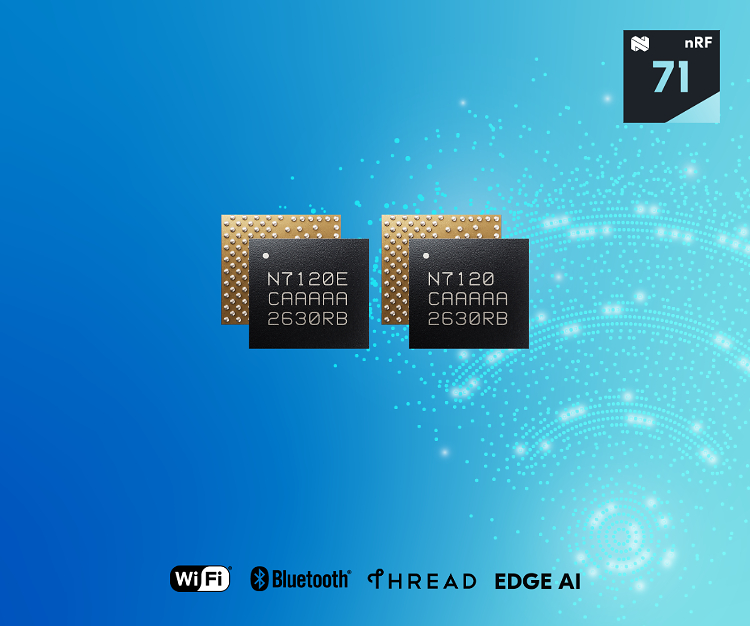
The first products in the range are the nRF7120 and nRF7120E. Both integrate Wi-Fi connectivity, a 2.4 GHz multiprotocol radio and an application processor.
The nRF7120 supports dual-band Wi-Fi 6 across the 2.4 GHz and 5 GHz bands. The nRF7120E adds support for the 6 GHz band, enabling tri-band Wi-Fi 6E, and includes Nordic’s Axon Neural Processing Unit (NPU) for hardware-accelerated AI workloads.
Both chips feature a 256 MHz Arm Cortex-M33 application processor, a 256 MHz RISC-V coprocessor, 4 MB of non-volatile memory and 1 MB of user-accessible RAM. This integrated architecture is intended to reduce the number of separate components required in connected device designs.
The company says the Axon NPU can run machine-learning models between 10 and 17 times faster than the Cortex-M33 processor alone. This is designed to make applications such as keyword spotting, anomaly detection and image classification more practical on compact, battery-powered devices.
The base nRF7120 can also support smaller AI models built using Nordic’s Neuton software, which runs inference on the application processor without requiring a dedicated NPU.
Nordic nRF71 Series Targets Longer Battery Life in Connected Devices
The headline improvement is the claimed reduction in standby power consumption. Nordic says the nRF71 Series delivers up to 20 times lower standby power usage than its current-generation nRF70 Wi-Fi products.
This matters because many connected devices need to remain available on a network even when they are not actively transmitting data. Smart locks, security panels and industrial sensors, for example, may spend much of their operating time in standby while waiting for a command, event or sensor reading.
The nRF71 architecture is designed to use low-power Wi-Fi features such as Target Wake Time and Wi-Fi power-saving mechanisms. These allow devices to coordinate when they wake up to communicate, rather than maintaining continuous high-power activity.
Nordic’s stated objective is to make Wi-Fi more viable in products that traditionally rely on lower-power wireless technologies because of battery constraints. Actual battery life will, however, depend on device design, network conditions, transmission frequency, software configuration and the workload being processed.
Nordic nRF71 Series Enables AI Processing Without Cloud Dependence
Another important feature is the ability to run AI inference directly on the device. Instead of continuously sending raw data to a cloud server for analysis, a connected product can process information locally and transmit only the resulting insight or event.
For example, an industrial sensor could identify an unusual operating pattern, while a smart home device could recognise a voice command or detect a specific activity. This approach can reduce data transmission, improve response times and limit the amount of information that needs to leave the device.
Nordic’s Axon NPU supports more demanding machine-learning workloads, while its Neuton software enables developers to create smaller models that can run on the main processor. The company also supports over-the-air model updates through its nRF Cloud platform, allowing deployed devices to receive updated AI models.
Local processing can also offer privacy advantages in applications involving audio, images or personal activity data. However, the extent of these benefits depends on how each product is designed and whether information is still transmitted to external services for other functions.
Nordic nRF71 Series Supports Smart Home and Industrial IoT Applications
The integrated connectivity architecture is designed for products that need to use multiple wireless protocols simultaneously.
The two independent radios have separate RF and processing blocks and can receive signals at the same time. This allows a device to maintain a Wi-Fi connection while also listening for Bluetooth Low Energy or Thread traffic.
This is relevant to Matter-enabled smart home products. A smart home hub, Matter bridge or Thread border router could use Wi-Fi for network connectivity while relying on Bluetooth LE for commissioning and Thread for communication with compatible devices.
The same architecture could support smart locks, security panels, wearables and industrial sensors. Manufacturers may also benefit from reduced component requirements and simpler hardware designs when integrating several wireless functions into a single product.
The nRF71 Series is compatible with Nordic’s nRF Connect SDK, which is also used across its nRF54 and nRF70 product families. This is intended to give developers a familiar software environment when moving to the new platform.
Nordic nRF71 Series Begins Sampling With Selected Customers
Nordic Semiconductor said the nRF71 Series is now sampling with selected customers. The company has not announced broad commercial availability, and developers interested in the chips have been advised to contact their local Nordic sales representatives.
The company will also showcase the nRF71 Series, including a Nordic-branded module, at Electronica 2026 in Hall C6, Booth 159.
Founded in Norway, Nordic Semiconductor develops low-power wireless connectivity solutions for consumer, healthcare and industrial IoT applications. Its product portfolio includes Bluetooth LE, Wi-Fi, cellular IoT and related software and cloud services.
The nRF71 launch reflects a wider direction in the semiconductor industry, where AI processing is increasingly being integrated into smaller devices rather than being restricted to data centres or high-performance computing systems. By combining connectivity and local intelligence with a focus on power efficiency, Nordic is targeting a category of connected products where battery life remains as important as computing capability.