Airoha 50G PON brings 50 Gbps symmetric broadband and AI to next generation networks
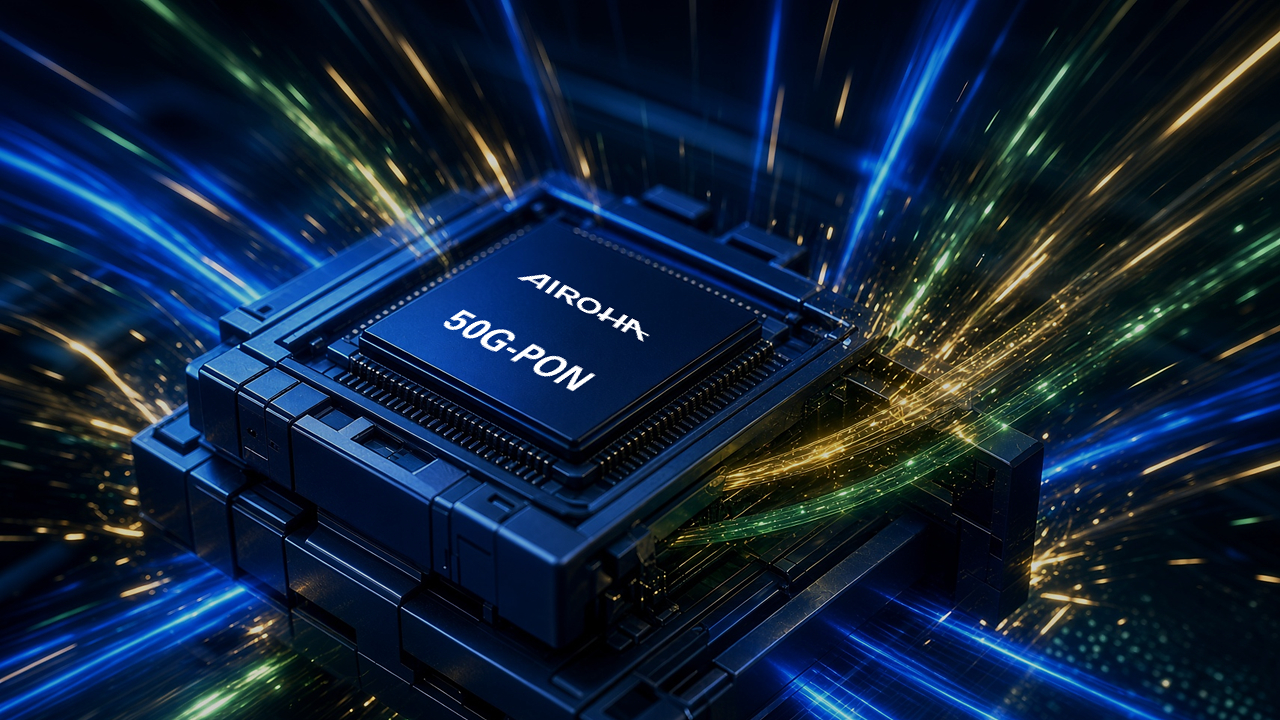
Airoha Technology is showcasing a next-generation 50G-PON AI Gateway Processor at Network X 2026, combining high-speed fiber access with Wi-Fi 8, Ethernet and edge artificial intelligence. The platform is designed to deliver 50 Gbps downstream and 50 Gbps upstream transmission while adding AI-powered network diagnostics and self-healing capabilities.
The development comes as telecom operators face rapidly increasing bandwidth requirements from AI applications, cloud computing, 8K video, extended reality and connected industrial systems.
Airoha 50G PON delivers 50 Gbps symmetric transmission
Airoha’s 50G-PON platform is designed to provide symmetrical 50 Gbps transmission in both directions. The company says the technology can deliver up to five times the transmission speed and up to 80% lower latency compared with XGS-PON.
The processor combines PON connectivity with Ethernet interfaces and Wi-Fi 8 in a single gateway architecture. This allows the same platform to handle high-speed fiber access, wired networking and wireless connectivity without requiring separate processing systems for each function.
The move toward 50G-PON is particularly relevant as broadband networks evolve from supporting conventional internet access to handling increasingly demanding cloud and AI workloads.
Airoha 50G PON integrates Wi-Fi 8 and edge AI
The new gateway processor goes beyond bandwidth improvements by incorporating TOPS-level computing capabilities for AI workloads.
Airoha says the platform can support multiple mainstream AI models directly on the gateway. This creates opportunities for operators to deliver AI-powered services closer to users rather than relying entirely on remote cloud infrastructure.
The processor is also designed to simultaneously manage PON traffic, Ethernet connections, Wi-Fi 8 and encrypted packet processing. Such integration could help operators reduce hardware complexity while supporting the growing number of connected devices in homes, businesses and industrial environments.
The platform also includes support for post-quantum cryptography, giving network operators a pathway toward stronger security as quantum computing develops.
Airoha 50G PON brings AI agents into broadband diagnostics
One of the more notable elements of the platform is its use of AI agents for broadband troubleshooting.
Airoha’s solution uses a large language model-based AI agent with chipset-specific domain knowledge. The agent can examine information such as device telemetry, network status and diagnostic data to identify potential causes of connectivity problems.
Users could describe an issue in natural language, such as poor Wi-Fi performance or an unstable connection. The system can then analyse the available network information and recommend corrective actions or, where permitted, execute safe remediation steps.
This could allow telecom operators to automate portions of customer support and network maintenance while reducing the need for manual troubleshooting.
Airoha 50G PON supports self healing broadband networks
The AI capabilities are also intended to support automated anomaly detection and network self-healing.
Common problems such as incorrect configurations, overloaded devices, abnormal optical network unit status and wireless signal issues can require significant diagnostic work. By processing network information locally, an AI-enabled gateway could potentially identify these issues faster and initiate corrective measures.
Airoha says its existing fixed broadband chipsets use CPU and RISC-V architectures to run LLM-based intelligent agents without requiring extremely high levels of dedicated AI computing power.
The approach illustrates how intelligence is gradually moving from centralized network management systems toward the network edge itself.
Airoha 50G PON targets AI native broadband infrastructure
The broader significance of Airoha’s platform lies in the convergence of connectivity and computing.
Traditional broadband gateways primarily acted as networking equipment, moving data between homes and external networks. Newer platforms are increasingly expected to process information, run applications, manage connected devices and provide intelligent network services.
Airoha’s 50G-PON architecture reflects this shift by bringing fiber connectivity, wireless networking, packet processing and AI capabilities into a single platform.
For telecom operators, this could provide a foundation for future AI-native broadband services while also helping support bandwidth-intensive applications such as cloud gaming, remote healthcare, AR and MR, smart manufacturing and high-resolution video.
Airoha 50G PON points toward intelligent broadband networks
Airoha and parent company MediaTek are demonstrating the technology at Network X 2026 in Vienna as part of a broader push toward next-generation connectivity.
The companies are also highlighting the transition from Wi-Fi 7 to Wi-Fi 8, XGS-PON to 50G-PON and 5G to 5G-Advanced. Together, these technologies point toward networks designed not only for greater bandwidth but also for lower latency, energy efficiency and intelligent service management.
The move to 50G-PON will ultimately depend on operator adoption, infrastructure upgrades and the economics of deploying next-generation fiber equipment. However, combining high-speed optical access with edge AI could make future broadband gateways considerably more capable than today’s connectivity equipment.