VapusData OS Brings Governed AI Workflows to Enterprise Systems
VapusData has introduced VapusData OS, a decentralised AI data operating system designed to help enterprises integrate artificial intelligence into existing business systems while maintaining control over data, permissions and automated processes.
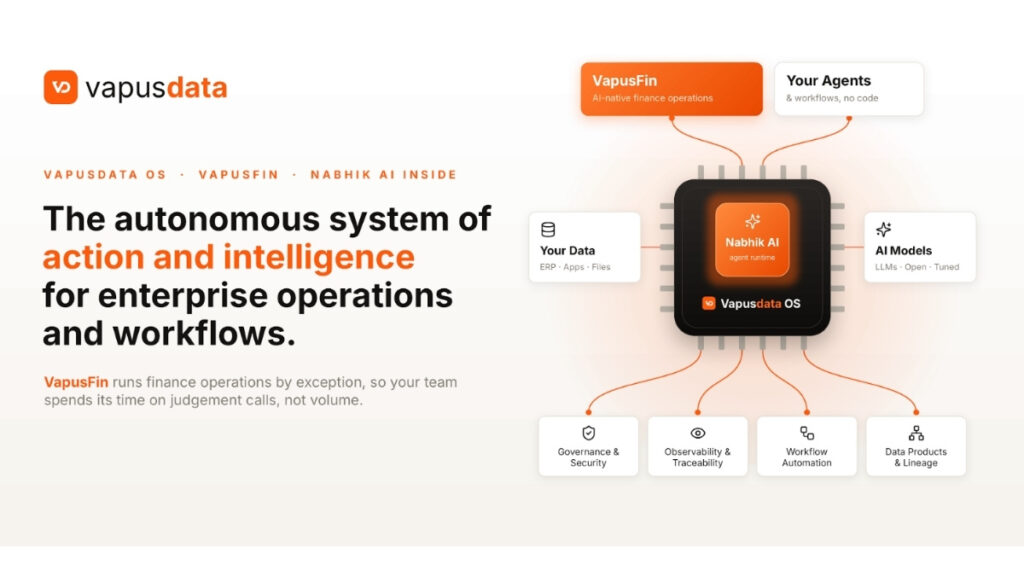
The platform connects enterprise data, applications and infrastructure with AI models, governed data products and autonomous workflows. Rather than requiring businesses to replace their existing technology stack or build separate environments for each AI project, VapusData OS is designed to let AI operate across systems already used by an organisation.
The launch addresses a growing challenge for enterprises moving beyond AI experimentation. While organisations are exploring generative AI and autonomous agents, deploying these technologies in production requires more than model access. Businesses also need reliable data, defined permissions, traceable actions and safeguards that align automated work with established operating rules.
VapusData OS Connects Enterprise Data With AI Workflows
VapusData OS brings together data connectors, data lineage, model management, workflow orchestration, APIs and monitoring capabilities within a unified operating layer.
The platform is designed to connect information across databases, enterprise applications, documents and cloud infrastructure without requiring all underlying data to be moved into a new central repository. This approach can be relevant to businesses that operate across multiple systems and need AI applications to work with information held in different environments.
The operating system also supports the creation and deployment of AI-powered workflows across connected applications. Teams can build processes that retrieve information, apply business rules, generate outputs and pass results to other systems.
According to VapusData, the platform supports more than 50 integrations across enterprise applications, databases and AI model providers. These include systems such as SAP, Oracle and Microsoft Dynamics.
The objective is to reduce the complexity of connecting individual AI projects to enterprise infrastructure while allowing organisations to retain control over how information is accessed and used.
VapusData OS Builds Governance Into Autonomous AI
A central feature of VapusData OS is its emphasis on governance and traceability. As AI agents take on more operational tasks, enterprises need ways to determine what information they can access, which actions they can perform and when human approval is required.
The platform incorporates access controls, policy management, audit trails and workflow oversight into its operating layer. It is designed to support deployment across shared cloud services, dedicated environments, on-premises infrastructure and air-gapped systems where network connectivity is restricted.
These options can be important for organisations handling confidential business information or operating under specific data-residency and security requirements.
Governance controls do not eliminate every risk associated with AI-generated decisions or automated actions. Their effectiveness depends on how policies are configured, how systems are integrated and whether organisations regularly review performance and exceptions.
VapusData’s approach is to make these controls part of the workflow architecture rather than treating them as an additional layer applied after an AI application has been developed.
VapusData OS Uses Nabhik AI to Execute Enterprise Tasks
The platform’s agentic execution layer, Nabhik AI, is designed to take workflows from an initial trigger through to an operational outcome.
Agents can perform tasks such as extracting information from documents, validating records, reconciling transactions, applying business rules, routing approvals and writing results back to enterprise systems. Human review and approval checkpoints can be incorporated into the process where required.
For example, a finance workflow could retrieve invoice information, compare it with purchase records, identify discrepancies and route exceptions to the appropriate employee. Instead of simply generating a recommendation, the system is designed to coordinate the steps involved in completing the task.
This distinction is significant for enterprise AI adoption. Businesses often need automation that can interact with existing applications and complete defined processes, not just answer questions or summarise documents.
The extent of automation will depend on the workflow, the quality of available data and the controls established by the organisation. Processes involving financial commitments, regulatory obligations or sensitive decisions may still require human intervention.
VapusData OS Supports Finance Automation Through VapusFin
One application built on the platform is VapusFin, which focuses on finance and accounting workflows. Its use cases include accounts payable, accounts receivable, reconciliation, taxation, claims processing and reporting.
VapusData reports that VapusFin has processed more than two million documents autonomously. The company also cites a deployment handling approximately 100,000 invoices a day for a large retail organisation.
The company reports first-pass document extraction accuracy above 99% across production use cases. In one deployment, it says the exception rate declined from 18% to 2%, while weekly reconciliation effort fell from 40 hours to two hours.
These are company-reported results rather than independently audited performance figures, and outcomes may vary by implementation, document quality and workflow complexity.
Nevertheless, finance automation provides a practical example of how an enterprise AI platform can be applied to repeatable operational work. By connecting document processing, validation, reconciliation and approval steps, businesses can aim to reduce manual effort while retaining visibility into exceptions and decisions.
VapusData OS Targets Multiple Enterprise Industries
Although finance automation is a prominent application, VapusData says its platform is intended for a wider range of industries, including banking, insurance, retail, e-commerce, logistics, real estate, education and cash management.
These sectors often rely on large volumes of documents, transactions and operational records distributed across multiple systems. AI workflows can help retrieve information, validate records and coordinate routine tasks, provided the underlying data and processes are sufficiently reliable.
The company cites deployments involving more than 3,000 vendors in automated claims processing, approximately 40,000 ATMs supported through cash-management reconciliation and around 3,000 lease agreements made searchable through document intelligence.
Such examples illustrate the types of operational environments the platform is designed to support. The business value in each case depends on implementation quality, integration with existing systems and the extent to which automation reduces processing time or errors.
For enterprises, the challenge is not simply deploying AI but making it work consistently across real business processes.
VapusData OS Reflects the Shift From AI Experiments to Operations
The introduction of VapusData OS reflects a broader enterprise technology trend: moving from isolated AI assistants towards systems that can coordinate data, models and automated actions across an organisation.
For businesses, this shift requires an operating foundation that supports integration, governance, monitoring and accountability. A platform that connects these capabilities could simplify deployment across multiple use cases, although organisations will still need to evaluate security, performance, cost and suitability for their individual requirements.
VapusData positions its operating system as a way to make AI more practical within existing enterprise environments, without forcing companies to rebuild their technology infrastructure.
Its long-term value will depend on whether the platform can deliver reliable outcomes at scale while maintaining the controls businesses require. As enterprises continue to move AI into production, the combination of autonomous execution and governance is likely to remain a central consideration in technology adoption.