
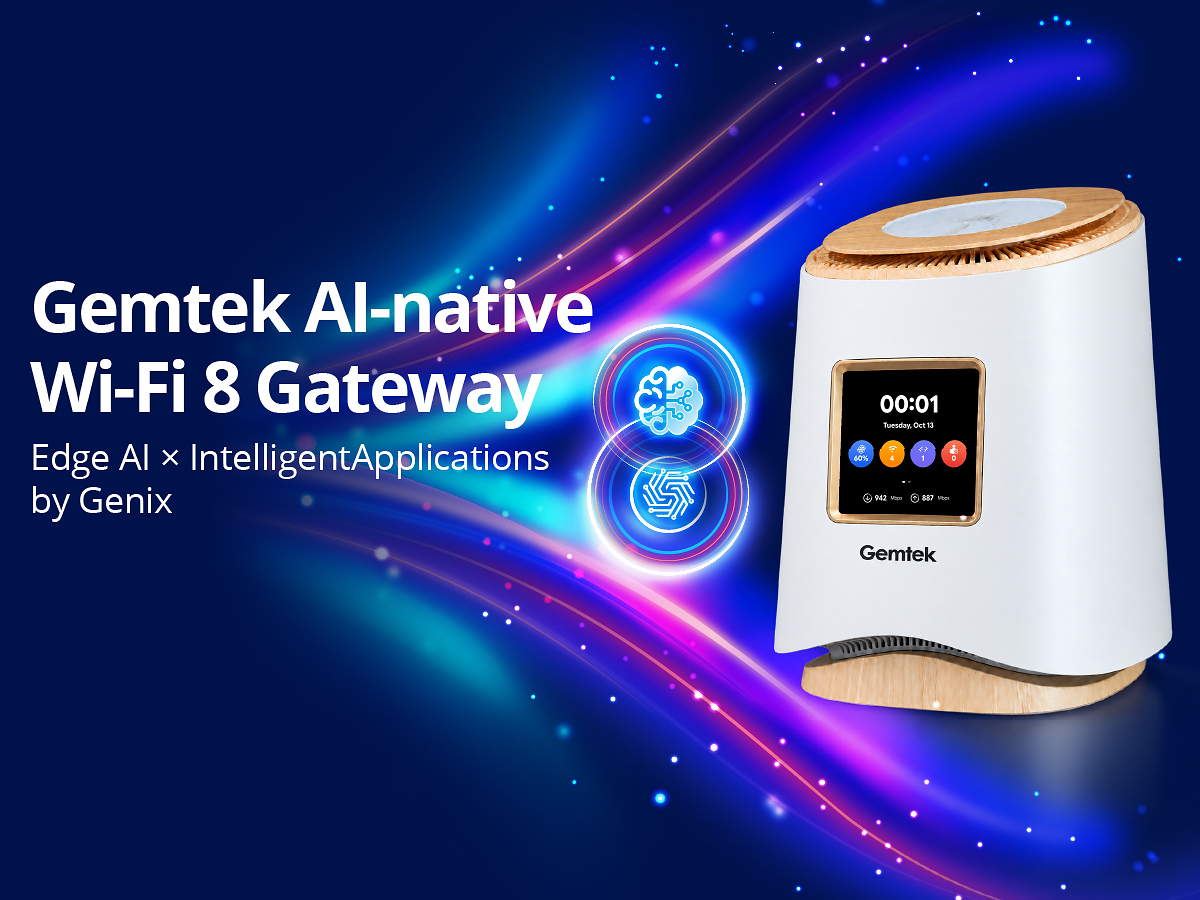
AI-Native Wi-Fi 8 Gateway Brings Edge AI to Home Broadband
An AI-Native Wi-Fi 8 Gateway developed through a collaboration between Gemtek Technology, Qualcomm Technologies and gFiber is set to bring artificial intelligence directly into home broadband infrastructure. The device combines next-generation Wi-Fi 8 connectivity with on-device AI processing, positioning the traditional home router as a platform for intelligent network management, connected-home services and voice-driven interactions.
Announced at Network X 2026, the gateway is built on Qualcomm’s Dragonwing NPro A8 Elite Platform, engineered by Gemtek and supported by intelligent software from Genix Networks, a Gemtek subsidiary. gFiber, formerly Google Fiber, will serve as the launch service provider, with commercial deployment targeted for 2027.
The development reflects a broader shift in telecommunications, as broadband providers look beyond internet speeds to deliver smarter, more personalised and responsive digital experiences.
AI-Native Wi-Fi 8 Gateway Combines Connectivity and Local Intelligence
The new gateway integrates quad-band Wi-Fi 8 connectivity with dedicated AI computing hardware, including a Qualcomm Hexagon Neural Processing Unit (NPU) and a high-performance penta-core CPU.
This architecture is designed to run supported AI applications directly on the gateway rather than relying entirely on remote cloud infrastructure. By processing certain requests locally, the system aims to improve responsiveness and help keep sensitive home-network information within the household.
The gateway also incorporates software capabilities from Genix Networks, connecting the router, household devices and network management functions through an AI-driven interface.
The approach represents an evolution in customer-premises equipment, or CPE, which traditionally focuses on delivering connectivity. In this model, the gateway becomes an intelligent service platform that can support network diagnostics, device awareness, security features and additional applications.
AI-Native Wi-Fi 8 Gateway Supports Voice-Controlled Network Management
One of the proposed features is the ability to manage the home network using natural-language voice commands. Instead of navigating multiple settings and menus, users could issue requests for supported network actions through conversational instructions.
For example, the system is designed to support requests to pause social media access on a child’s devices until a specified time. Such intent-based parental controls could make network management more accessible to households without requiring users to understand technical configuration settings.
The device is also designed to simplify guest access. Users will be able to initiate guest credential sharing through voice commands, with a QR code displayed on the gateway’s interactive touchscreen to help visitors connect.
Other planned capabilities include voice-controlled application integration, personalised interfaces and real-time network health diagnostics.
These features are intended to make broadband management more intuitive. Their practical value, however, will depend on the supported applications, software implementation and service experience available when the device reaches customers.
AI-Native Wi-Fi 8 Gateway Targets Faster and More Responsive Broadband
The gateway is designed to support gFiber’s symmetrical 20-gigabit broadband service, offering the same nominal maximum speed for downloads and uploads. This makes it relevant to demanding home and business environments that use bandwidth-intensive applications, large file transfers, cloud services and connected devices.
Wi-Fi 8, also known as IEEE 802.11bn, is intended to improve wireless reliability, responsiveness and performance in challenging network conditions. The platform combines these next-generation wireless capabilities with mesh networking and spectrum-efficiency enhancements.
The distinction between broadband speed and Wi-Fi performance remains important. A high-speed fibre connection does not automatically guarantee equivalent speeds across every wireless device or room. Network congestion, physical obstructions, device compatibility and interference can all affect real-world performance.
By combining advanced connectivity with local intelligence, the new gateway aims to address both network performance and the way users interact with their home internet systems.
AI-Native Wi-Fi 8 Gateway Emphasises Privacy and Edge Computing
Moving AI processing closer to the user is a central part of the gateway’s design. Edge AI enables supported workloads to run on local hardware, potentially reducing the need to send every request to a cloud-based service.
This approach can offer lower response times and help limit the transfer of sensitive network information outside the home. It may also allow certain functions to continue with less dependence on external AI infrastructure.
However, local processing does not automatically guarantee complete privacy. The level of protection will depend on how individual applications handle data, what information is transmitted to external services and how software updates and security controls are implemented.
For broadband operators, integrating AI into gateways could also create opportunities to offer differentiated services, including personalised network controls, proactive diagnostics and additional connected-home applications.
AI-Native Wi-Fi 8 Gateway Brings Three Companies Together
Each company has a distinct role in the collaboration.
Gemtek is responsible for product engineering and system integration, bringing together the gateway hardware and software capabilities developed through its Genix Networks subsidiary. Qualcomm contributes the Dragonwing networking platform and associated connectivity and AI technologies. gFiber will shape the subscriber experience and become the first service provider to deploy the device.
The partnership combines hardware development, AI software and broadband service delivery in a single product strategy. This coordinated approach is important because the success of an AI-enabled gateway will depend not only on its processing capabilities but also on the services operators can deploy and maintain.
The companies plan to target commercial deployment in 2027. Existing gFiber customers subscribed to its 20-gigabit service are expected to be the first users of the new gateway once it completes the required certification process.
AI-Native Wi-Fi 8 Gateway Points to the Future of Connected Homes
The device’s design also challenges the traditional approach of hiding routers in cupboards or utility spaces. Its intended living-room placement is designed to keep wireless equipment in a more open position, potentially helping reduce signal obstruction while making the interface more accessible.
The underlying hardware architecture is also intended to accommodate future broadband services, including speeds of up to 50 gigabits. Such capabilities remain part of the longer-term roadmap rather than a statement of currently available service.
For the wider broadband industry, the collaboration illustrates how routers and gateways could evolve from largely invisible networking equipment into platforms for AI-powered services. The immediate opportunity lies in making home networks easier to manage, more responsive and better equipped for growing numbers of connected devices.
Whether these capabilities translate into a meaningful consumer advantage will ultimately depend on certification, service availability, software reliability and the quality of the applications offered. Nevertheless, the project signals an emerging direction for broadband infrastructure, where connectivity and local intelligence are designed to work together from the outset.