ZyG Score uses agentic AI to identify the next breakout eCommerce brands
ZyG has launched the ZyG Score, an AI-powered evaluation system designed to identify consumer brands with the potential to scale into businesses generating hundreds of millions of dollars in annual online sales. The platform aims to replace intuition-driven product selection with a combination of market analysis, artificial intelligence and real-world consumer testing.
Announced on October 12, 2026, the launch introduces a process that evaluates a brand’s market opportunity, tests its appeal with actual consumers and identifies products that may be suitable for accelerated growth.
ZyG says consumer brands generating more than $1 million in online sales can receive an initial assessment at no cost. The initiative is designed to help founders understand their growth potential before committing substantial resources to marketing and customer acquisition.
ZyG Score uses agentic AI to evaluate eCommerce growth potential
The ZyG Score begins with a proprietary assessment called ZyGnal, which uses AI agents to analyse a brand’s market opportunity, competitive landscape and potential routes to growth.
The assessment considers factors such as product value proposition, brand positioning, pricing, audience demand and competitive differentiation. Instead of relying solely on historical sales figures or founder assumptions, the system aims to identify how a product could perform in a larger market.
This approach addresses a common challenge for direct-to-consumer brands. A product may generate promising early sales but struggle to scale because of weak differentiation, high acquisition costs or limited customer demand.
By analysing these factors before significant expansion, ZyG aims to help businesses identify potential obstacles and determine where further investment may be justified.
ZyG Score combines AI analysis with real consumer testing
Brands that perform strongly in the initial ZyGnal assessment can progress to a Marketability Test, where ZyG uses its AI agent network to develop positioning, creative assets, offers and storefront experiences.
These assets are then tested with consumers in the United States to measure actual market response.
The testing process is intended to generate predictive performance indicators, including estimates related to customer lifetime value. By combining market analysis with observed consumer behaviour, ZyG aims to provide a more evidence-based assessment of whether a product can achieve profitable growth.
The distinction is important because AI-generated forecasts alone cannot establish whether customers will purchase a product. Real-world testing provides another layer of evidence before a company commits to scaling its marketing spend.
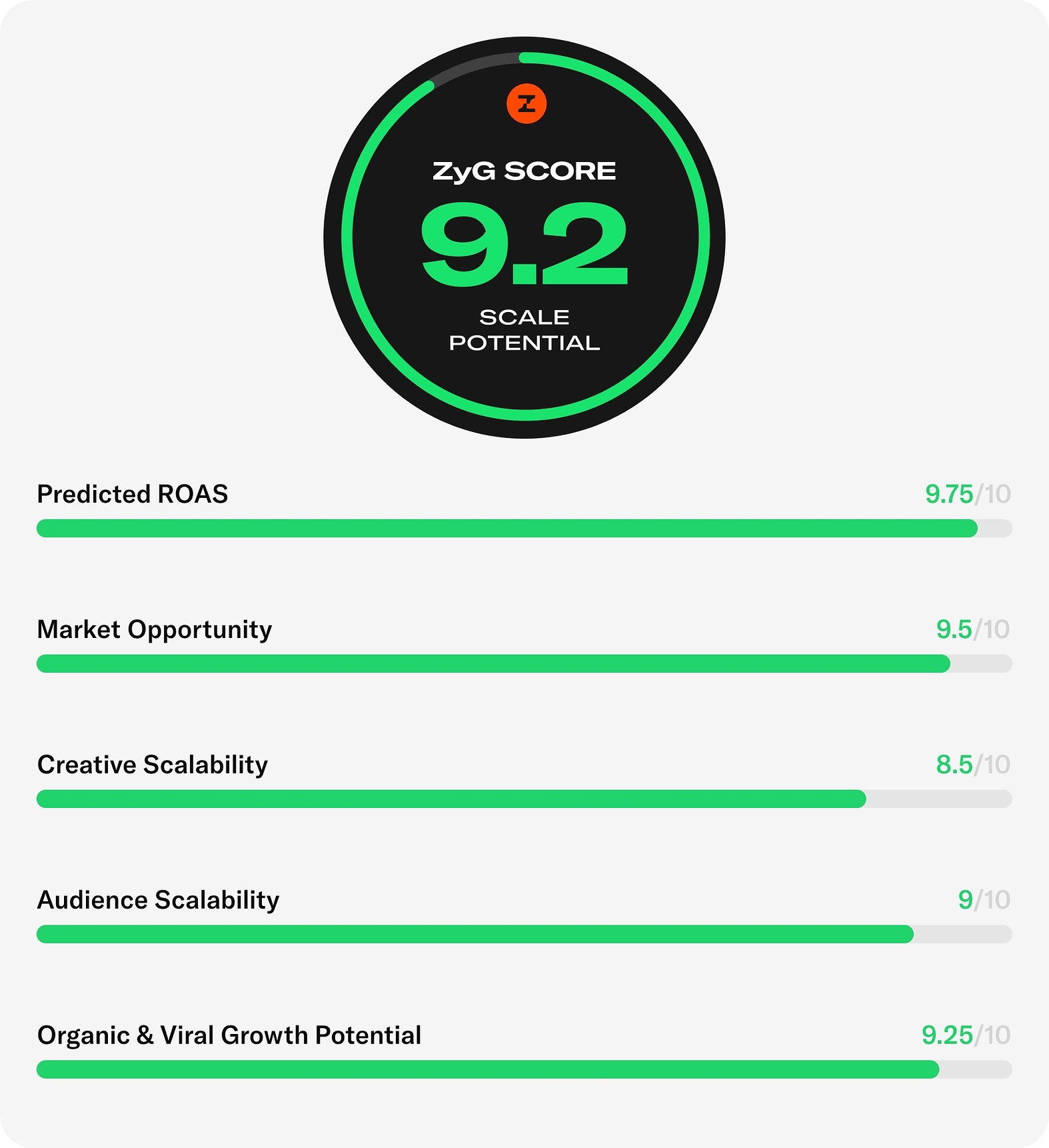
The resulting assessment combines the initial market analysis and consumer testing into the ZyG Score, which is intended to serve as a signal of a product’s potential to scale.
ZyG Score offers selected brands a $10,000 growth test
ZyG plans to fully fund Marketability Tests for the 500 brands with the strongest initial ZyGnal assessments, investing $10,000 of its own capital in media spending for each selected brand.
The programme creates an opportunity for qualifying businesses to test their products with consumers without having to finance that initial media spend themselves.
Brands that demonstrate strong potential through the process may be invited to become ZyG Scale Partners. The company can then help them execute their growth strategies, with services covering areas such as branding, advertising, conversion optimisation, retention and logistics.
ZyG also says it can provide financing for customer acquisition, addressing a major challenge for growing eCommerce businesses that need capital to expand but may lack the resources to fund aggressive marketing campaigns.
Selection for the funded programme is limited to the brands that perform most strongly in the initial assessment.
ZyG Score connects AI agents with eCommerce execution
The launch forms part of ZyG’s wider operating system for eCommerce growth. Rather than offering only a standalone analytics tool, the company aims to connect product validation, marketing execution and financing within one operating model.
Its AI agents are designed to support different growth functions, with information shared across the system to help coordinate decisions. Insights from marketing performance, customer behaviour and conversion data can inform subsequent actions.
For example, a brand’s positioning can influence its advertising creative, while customer response can help guide future offers and marketing decisions. Connecting these activities can reduce the fragmentation that often occurs when businesses rely on separate agencies and software platforms.
The model reflects a broader move toward agentic AI systems that do more than generate recommendations. These systems are designed to coordinate tasks and support execution across connected business workflows, although their effectiveness depends on data quality, implementation and human oversight.
ZyG Score highlights a new approach to eCommerce brand scaling
The launch comes as direct-to-consumer businesses face pressure to demonstrate sustainable unit economics rather than pursuing revenue growth at any cost.
Customer acquisition costs, advertising competition and uncertain consumer demand can make scaling expensive. Brands that expand before validating their positioning or profitability may find it difficult to maintain growth.
ZyG’s approach attempts to address this challenge by combining AI-based analysis, consumer testing and execution support. The objective is to identify promising products earlier and provide selected brands with the operational resources needed to expand.
However, a strong assessment cannot guarantee long-term success. Consumer preferences change, advertising costs fluctuate and competitors can quickly respond to successful products. The value of the ZyG Score will ultimately depend on how accurately it identifies sustainable opportunities and how well the company helps brands convert those opportunities into profitable businesses.
The launch nevertheless illustrates how AI is being applied beyond content creation and customer service, moving into product validation, commercial decision-making and the execution of eCommerce growth strategies.